How Do I Learn English Grammar? A Step-by-Step Guide for Beginners
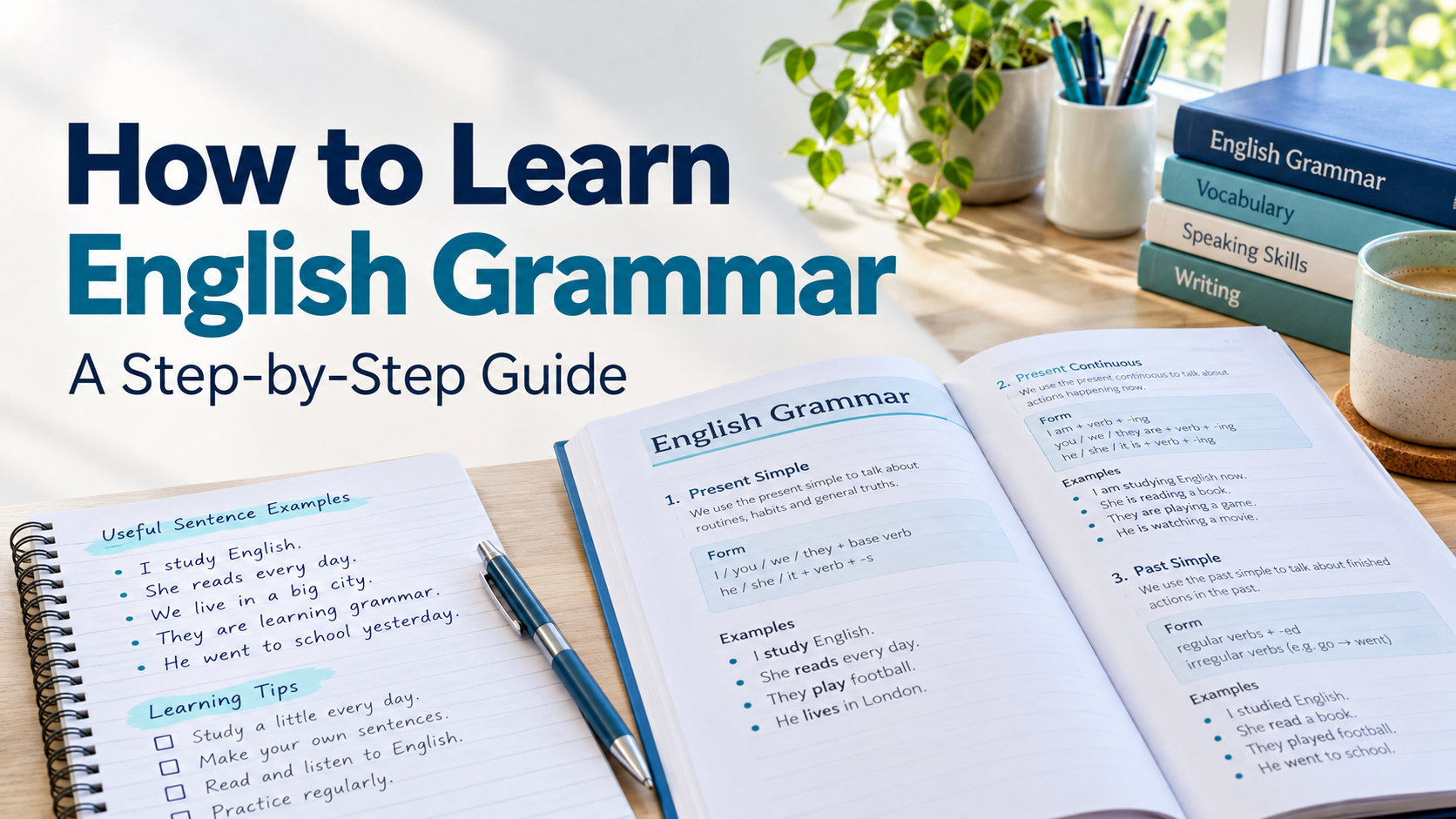
If you are asking, “How do I learn English grammar?” the answer is simple: start with basic sentence structures, learn one grammar rule at a time, and practice using those rules in real sentences.
Many English learners understand grammar explanations but struggle to use them when speaking or writing. This usually happens because knowing a rule and applying it automatically are two different skills.
You can improve by following a clear learning order, writing your own examples, correcting mistakes, and reviewing what you have studied.
This guide explains where to begin, which English grammar topics to learn first, how to practice effectively, and how to build a routine that supports steady improvement.
Start With the Basic Parts of English Grammar
Before studying complicated grammar rules, understand how English words work together.
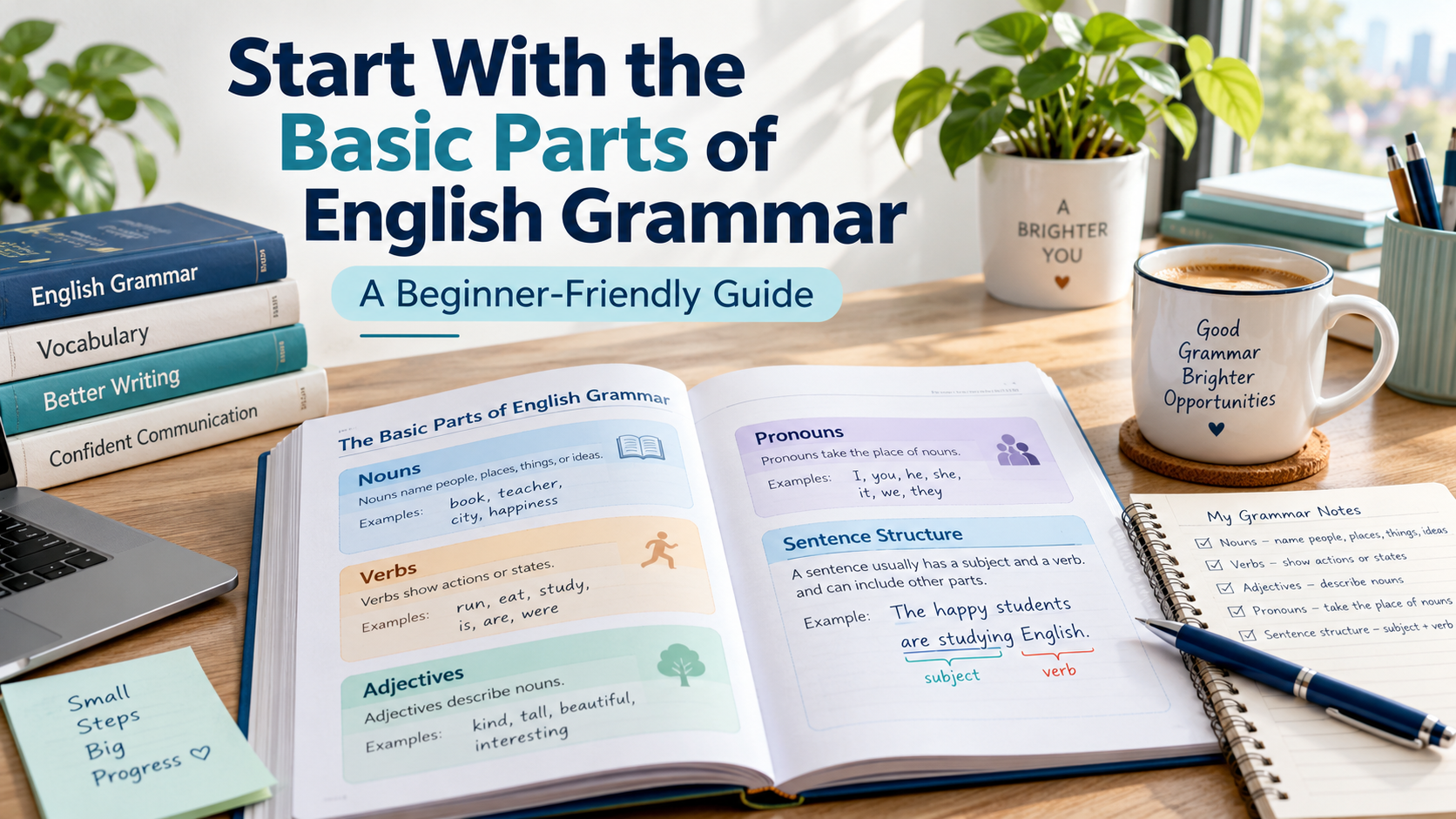
English grammar includes several important elements, such as nouns, pronouns, verbs, adjectives, tenses, and sentence structures.
Learn the Parts of Speech
Parts of speech explain the different jobs words perform in sentences.
| Part of Speech | Purpose | Example |
|---|---|---|
| Noun | Names a person, place, thing, or idea | Teacher, London, book |
| Pronoun | Replaces a noun | He, she, they |
| Verb | Describes an action or state | Read, play, is |
| Adjective | Describes a noun or pronoun | Beautiful, small |
| Adverb | Modifies a verb, adjective, or another adverb | Slowly, carefully |
| Preposition | Shows relationships of time, place, or direction | In, on, under |
| Conjunction | Connects words or clauses | And, but, because |
| Interjection | Expresses a reaction or emotion | Wow! Oh! |
Consider this sentence:
The intelligent student answered the question carefully.
Here:
-
Student is a noun.
-
Intelligent is an adjective.
-
Answered is a verb.
-
Carefully is an adverb.
Understanding these categories makes it easier to identify sentence patterns and recognize grammar mistakes.
You do not need to memorize every definition immediately. Focus on identifying the words in sentences you already understand.
Understand English Sentence Structure
Sentence structure is the foundation of How Do I Learn English Grammar because it determines how words are arranged to communicate meaning.
One common English sentence pattern is:
Subject + Verb + Object
For example:
-
Sara reads books.
-
Ahmed plays cricket.
-
My father drives a car.
-
The teacher explains the lesson.
In the sentence “Sara reads books”:
-
Subject: Sara
-
Verb: reads
-
Object: books
Not every English sentence needs an object.
For example:
The baby sleeps.
This sentence contains a subject and a verb, and it is grammatically complete.
Learn Affirmative, Negative, and Question Sentences
Once you understand simple sentences, practice changing them into negative sentences and questions.
| Sentence Type | Example |
|---|---|
| Affirmative | She likes coffee. |
| Negative | She does not like coffee. |
| Question | Does she like coffee? |
Notice that the main verb changes from likes to like when the auxiliary verb does is used.
Incorrect: Does she likes coffee?
Correct: Does she like coffee?
This happens because does already carries the third-person singular agreement.
Practice tip: Choose five simple affirmative sentences and change each one into a negative sentence and a question.
Learn English Tenses in a Logical Order
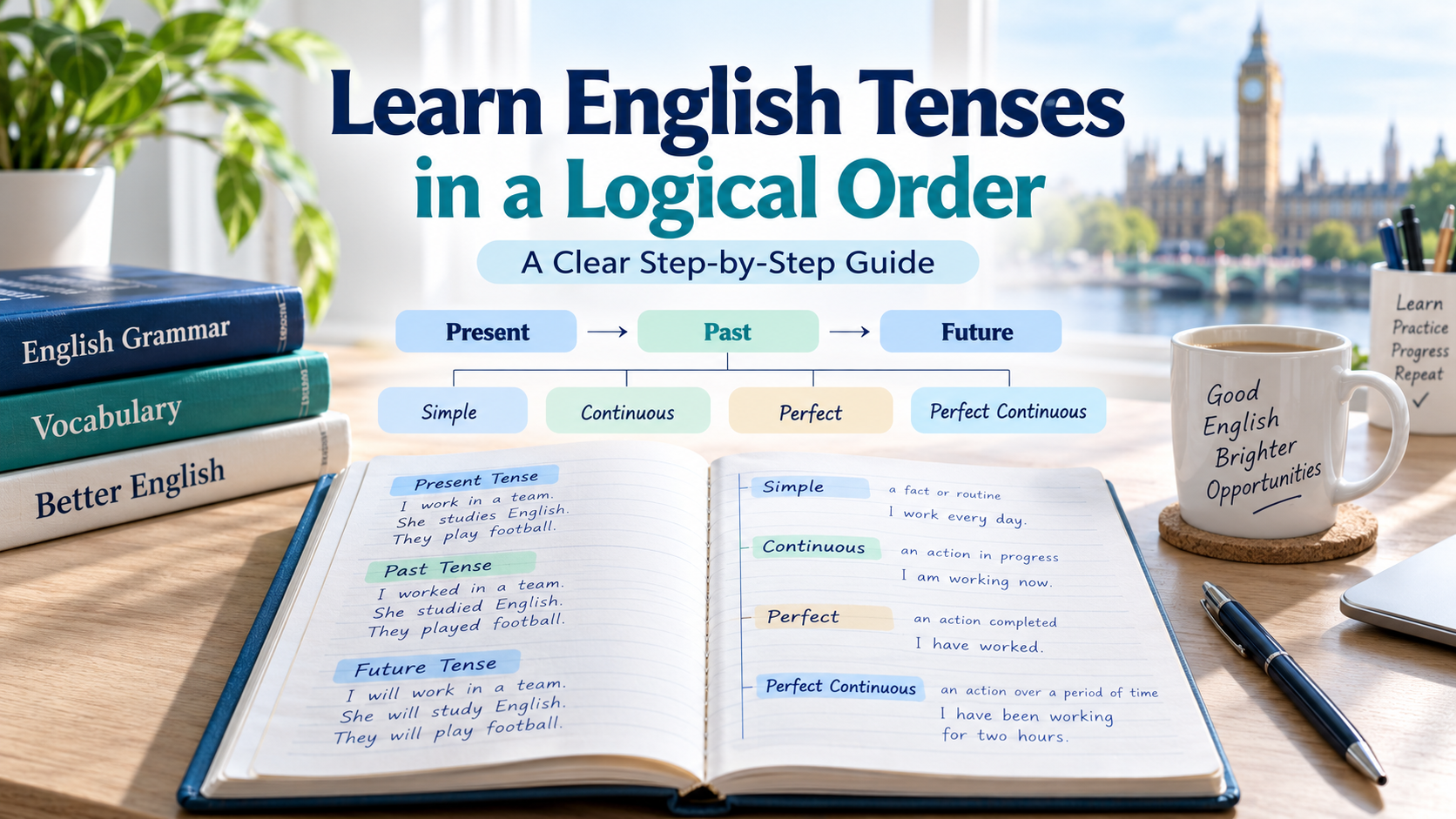
English tenses help you express when actions happen and how those actions relate to time.
Beginners often try to memorize all twelve commonly taught tense forms simultaneously. A more practical approach is to study the most frequently needed forms first and gradually add others.
Start With the Simple Present Tense
The simple present tense is used for habits, routines, general truths, and regular activities.
Structure:
Subject + Base Verb (with -s or -es for he, she, and it)
Examples:
-
I study English every day.
-
She works in a hospital.
-
They play football on Sundays.
Incorrect: He go to work every morning.
Correct: He goes to work every morning.
Learn the Present Continuous Tense
Use the present continuous tense for actions happening now or temporary situations.
Structure:
Subject + am/is/are + Verb-ing
Examples:
-
I am learning English grammar.
-
She is preparing dinner.
-
They are watching television.
Incorrect: I learning English.
Correct: I am learning English.
The helping verb am is necessary in this sentence.
Study the Simple Past Tense
The simple past tense describes completed actions in the past.
Structure:
Subject + Past Form of Verb
Examples:
-
I visited my grandmother yesterday.
-
She completed her assignment.
-
We watched a movie last night.
Incorrect: She go to the market yesterday.
Correct: She went to the market yesterday.
Go is an irregular verb, so its past form is went.
Learn Common Ways to Express the Future
English commonly uses will and be going to to discuss the future.
Structure with will:
Subject + Will + Base Verb
Examples:
-
I will call you tomorrow.
-
She will help her friend.
Structure with going to:
Subject + am/is/are + Going to + Base Verb
Examples:
-
I am going to study tonight.
-
They are going to visit their relatives.
Going to is often used for existing plans or predictions based on present evidence. Will is commonly used for decisions made at the moment of speaking, offers, and certain predictions.
As your grammar improves, continue with the present perfect, past continuous, past perfect, and other tense and aspect combinations.
Learn Subject-Verb Agreement
Subject-verb agreement means that the verb must match the subject according to the How Do I Learn English Grammar rules of the sentence.
In the simple present tense, most verbs take -s or -es when the subject is he, she, it, or a singular noun.
Examples:
-
He plays cricket.
-
She teaches English.
-
The dog barks loudly.
-
They play cricket.
Compare these sentences:
Incorrect: My brother work in a bank.
Correct: My brother works in a bank.
Incorrect: The students studies English.
Correct: The students study English.
Remember that the plural subject students takes the base verb study, not studies.
Learning subject-verb agreement helps prevent mistakes in everyday writing.
Understand Articles, Prepositions, and Pronouns
Small words can create significant grammar difficulties because their usage often depends on context.
Articles: A, An, and The
Use a and an when referring to a singular countable noun that is not specifically identified.
Use the when referring to something identifiable to both the speaker and listener, or something already mentioned.
Examples:
-
I bought a notebook.
-
She ate an orange.
-
The notebook is on my desk.
The choice between a and an depends on sound, not simply spelling.
For example:
-
An hour
-
A university
Hour begins with a vowel sound because the h is silent. University begins with a consonant sound, similar to y in yes.
Prepositions: In, On, and At
Prepositions help express time, place, movement, and other relationships.
Examples:
-
I live in Pakistan.
-
The book is on the table.
-
The meeting starts at 9 a.m.
-
She was born in July.
-
We have a lesson on Monday.
A useful starting point for time expressions is:
| Preposition | Common Use | Example |
|---|---|---|
| In | Months, years, longer periods | In December |
| On | Days and dates | On Friday |
| At | Specific clock times | At 8 p.m. |
These patterns have exceptions and other uses, so learn them through complete sentences rather than memorizing isolated words.
Pronouns
Pronouns replace nouns and help avoid unnecessary repetition.
Compare:
Without pronouns: Ayesha bought a book. Ayesha read the book. Ayesha liked the book.
With pronouns: Ayesha bought a book. She read it and liked it.
The second version sounds more natural and avoids repeating the same nouns.
Learn Grammar Through Real English Sentences
Learning grammar rules is important, but memorizing rules alone will not make you a confident English user.
You also need to understand how grammar works in actual communication.
Consider this example:
Rule: Use the present perfect to describe certain past experiences without mentioning a specific completed time.
Structure:
Subject + Have/Has + Past Participle
Example:
“I have visited Islamabad.”
Now compare:
“I visited Islamabad last year.”
The first sentence describes an experience without specifying when it happened. The second uses the simple past because it refers to a specific finished time.
Instead of only writing down the rule, create your own examples:
-
I have completed my homework.
-
She has already eaten lunch.
-
We have never visited that museum.
Then write similar examples using the simple past.
This approach helps you recognize the difference between grammatical forms and understand when each is appropriate.
Practice English Grammar Every Day
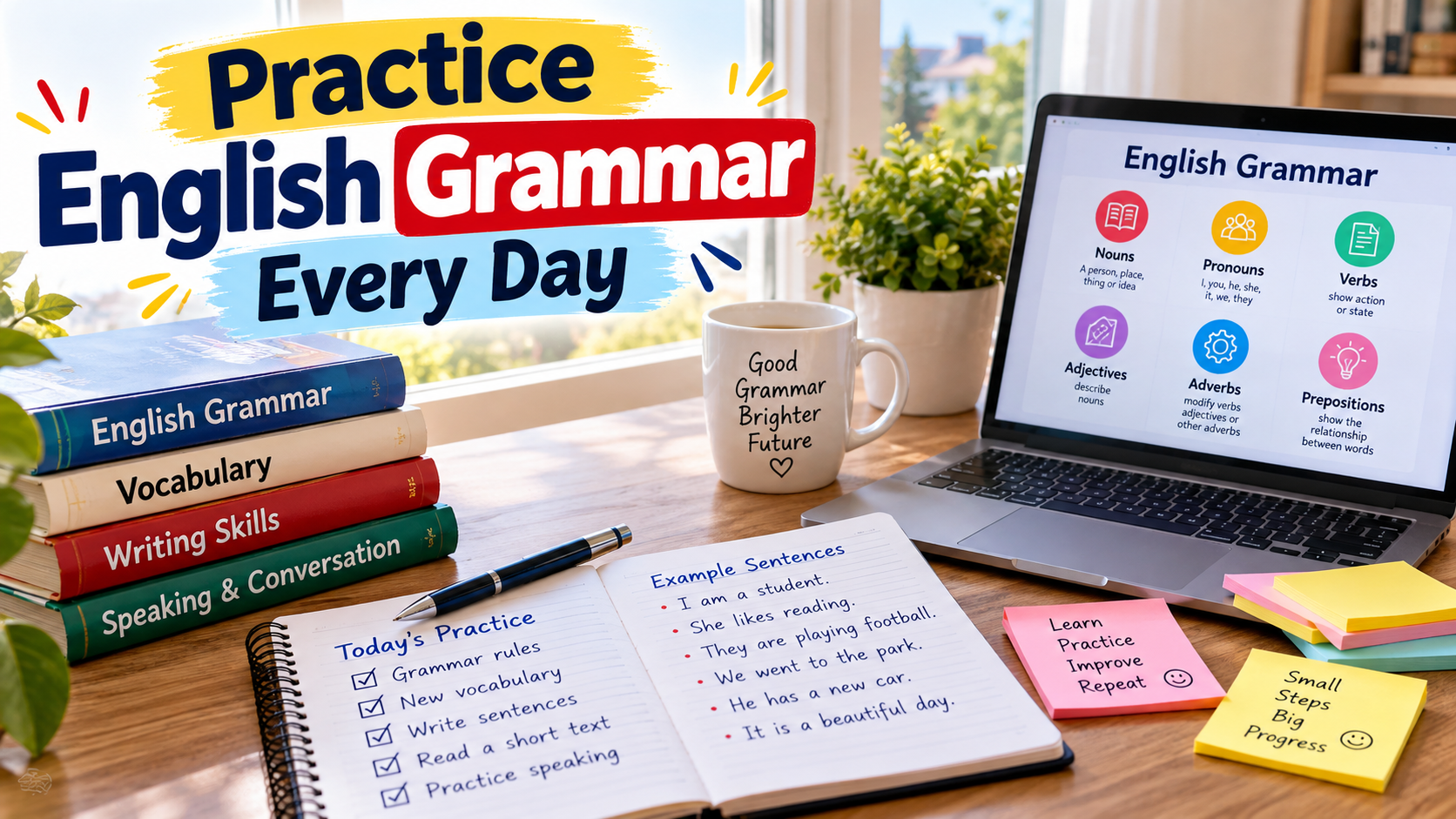
Regular practice is more useful than studying many rules once and forgetting them.
You can build a simple grammar routine even if you have only 20–30 minutes available daily.
A Simple 30-Minute Grammar Routine
| Time | Activity | What to Do |
|---|---|---|
| 5 minutes | Review | Review yesterday’s grammar topic |
| 10 minutes | Learn | Study one rule and its examples |
| 10 minutes | Write | Create five to eight original sentences |
| 5 minutes | Correct | Check mistakes and rewrite sentences |
For example, if today’s topic is the simple past tense, begin by reviewing regular and irregular verbs.
Next, write sentences about yesterday:
-
I woke up early.
-
I prepared breakfast.
-
I completed my work.
-
I talked to my friend.
Afterward, check whether the verbs are in the correct past forms.
The next day, briefly review the same topic before studying something new.
Keep a Grammar Mistake Notebook
A mistake notebook helps you focus on errors you repeatedly make.
For example:
| My Mistake | Correct Sentence | Rule |
|---|---|---|
| She don’t like tea. | She doesn’t like tea. | Use doesn’t with she |
| I am go to school. | I am going to school. | Present continuous requires -ing |
| He have a bicycle. | He has a bicycle. | Use has with he |
| I did not went there. | I did not go there. | Use base verb after did |
Review your notebook every few days and try writing fresh sentences that follow the corrected rules.
Improve Grammar Through Reading and Listening
Grammar becomes easier to understand when you encounter it repeatedly in meaningful contexts.
Read Simple English Every Day
Start with short passages, beginner-friendly stories, conversations, or articles.
While reading, pay attention to:
-
How sentences begin.
-
Which tense the writer uses.
-
How questions are formed.
-
Where articles and prepositions appear.
-
How conjunctions connect ideas.
For example, read this short paragraph:
“Maria wakes up at seven every morning. She prepares breakfast and walks to school. After school, she studies English and helps her mother at home.”
This passage uses the simple present tense to describe a regular routine.
Try rewriting it in the first person:
“I wake up at seven every morning. I prepare breakfast and walk to school.”
Notice how the verb forms change when the subject changes.
For additional exercises and reading-based learning, explore English grammar and reading practice and apply the structures you study to your own sentences.
Listen to Everyday English
Listening exposes you to common sentence structures in natural conversations.
Choose beginner-level English audio or videos with clear speech.
Listen for patterns such as:
-
“What are you doing?”
-
“I have finished my work.”
-
“Could you help me?”
-
“I was studying when you called.”
Repeat the sentences and try changing one element.
For example:
“I was cooking when she arrived.”
Change it to:
“I was reading when she arrived.”
You can also record yourself speaking and compare your sentences with the original examples.
Avoid Common English Grammar Mistakes
Some grammar mistakes appear frequently among English learners.
Learning to recognize them can improve both written and spoken communication.
Using the Wrong Verb Form
Incorrect: She did not completed the work.
Correct: She did not complete the work.
Explanation: After did not, use the base form of the main verb.
Forgetting Articles
Incorrect: He bought new laptop.
Correct: He bought a new laptop.
Explanation: A singular countable noun such as laptop normally needs a determiner.
Using Incorrect Prepositions
Incorrect: She is interested on science.
Correct: She is interested in science.
Explanation: The adjective interested commonly takes the preposition in when identifying a subject or activity.
Confusing Adjectives and Adverbs
Incorrect: He speaks English fluent.
Correct: He speaks English fluently.
Explanation: Fluently is an adverb describing how he speaks.
Creating Double Negatives
Incorrect in standard written English: I don’t know nothing.
Standard form: I don’t know anything.
Explanation: In standard English, anything is normally used with don’t to express this meaning. Negative concord, such as don’t know nothing, also occurs in some English dialects, but is generally avoided in formal standard writing.
Translating Sentences Word for Word
Direct translation from another language can produce unnatural English sentence structures.
For example:
Incorrect: I am having two brothers.
Correct: I have two brothers.
In ordinary English, have is generally used in its simple form when expressing possession or family relationships.
The best way to avoid translation-based mistakes is to learn complete English expressions and notice how native and proficient speakers use them.
Follow a Four-Week English Grammar Study Plan
A learning plan can help you avoid switching randomly between grammar topics.
Use this four-week schedule as a starting point, adjusting the pace when you need more practice.
| Week | Main Topics | Practical Goal |
|---|---|---|
| Week 1 | Parts of speech, basic sentences, pronouns | Write simple sentences accurately |
| Week 2 | Simple present, present continuous, simple past | Describe routines and past activities |
| Week 3 | Future expressions, articles, prepositions, agreement | Write short paragraphs with fewer basic errors |
| Week 4 | Questions, negatives, conjunctions, review | Write and speak using connected sentences |
At the end of each week, write a short paragraph using the grammar structures you studied.
For example, after Week 2, write about:
-
Your daily routine.
-
What you are doing this week.
-
What you did last weekend.
Review your paragraph and identify three areas that need improvement.
Four weeks can help establish a strong learning habit, but grammar proficiency develops over a longer period through practice, feedback, and repeated exposure.
Test Your English Grammar Knowledge
Use this short exercise to check your understanding of essential grammar rules.
Choose the Correct Answer
Grammar Practice Quiz
0 of 6 answered
1. She ___ English every evening.
2. They ___ watching television now.
3. I ___ my homework yesterday.
4. He bought ___ umbrella.
5. She did not ___ the answer.
6. My brother ___ a doctor.
Try Again
Conclusion
How Do I Learn English Grammar becomes more manageable when you follow a clear sequence and practice consistently. Start with parts of speech and simple sentence structures, then study verb tenses, subject-verb agreement, articles, prepositions, and more advanced patterns.
Use reading and listening to understand grammar in context, and improve your accuracy by writing original sentences and correcting recurring mistakes.
Start today: Choose one grammar topic from this guide, write five sentences using the rule, and review your mistakes before moving to the next lesson.
Frequently Asked Questions About Learning English Grammar
Can I learn English grammar by myself?
Yes. You can learn grammar independently through structured lessons, reading, listening, writing, and self-correction. A teacher or language partner can provide valuable feedback, especially when you are unsure why a sentence is incorrect.
Should I learn grammar or vocabulary first?
Learn them together. Grammar helps you organize words into sentences, while vocabulary gives you the words needed to express ideas. For example, learning the words eat, breakfast, and morning alongside the simple present tense allows you to write “I eat breakfast every morning.”
How long does it take to learn English grammar?
There is no fixed timeline. Your progress depends on your current level, study frequency, previous language experience, and how often you use English. Basic sentence patterns may become familiar relatively quickly, while using complex structures accurately and naturally usually requires sustained practice.
Is English grammar different in British and American English?
Most grammar rules are shared, but some usage patterns differ. For instance, British English often uses the present perfect with just: “I’ve just eaten.” American English also accepts this form but frequently uses “I just ate.” Both varieties are valid, and learners can choose one as their main model while becoming familiar with the other.
How can I remember grammar rules without memorizing everything?
Study each rule with several meaningful examples. Write sentences about your own life, revisit the topic after a few days, and practice retrieving the correct structure without looking at your notes. Using rules repeatedly in context helps them become easier to recall.
Why do I know grammar rules but still make mistakes when speaking?
Recognizing grammar and using it quickly are different skills. Speaking requires you to choose words, organize ideas, and produce sentences almost simultaneously. Short speaking exercises, repeated sentence patterns, and targeted feedback can help you apply grammar more automatically.