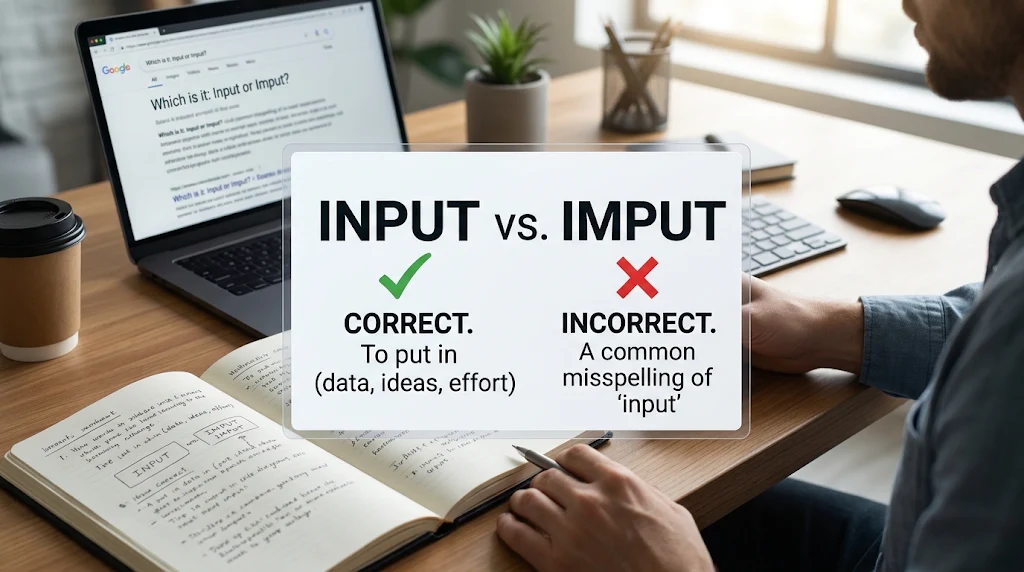
Input or Imput: Correct Spelling, Definition, and Usage Explained
Have you ever wondered whether the correct spelling is input or imput? Many English learners make this mistake when writing emails, completing assignments, or communicating online. Although both spellings may look similar, only one is accepted in standard English. The correct word is input, while imput is a common spelling mistake. In this article, you will learn the difference between input vs imput, discover the meaning of input, understand how to use it correctly, and explore practical examples to improve your English spelling and writing skills.
What Is the Difference Between Input and Imput?
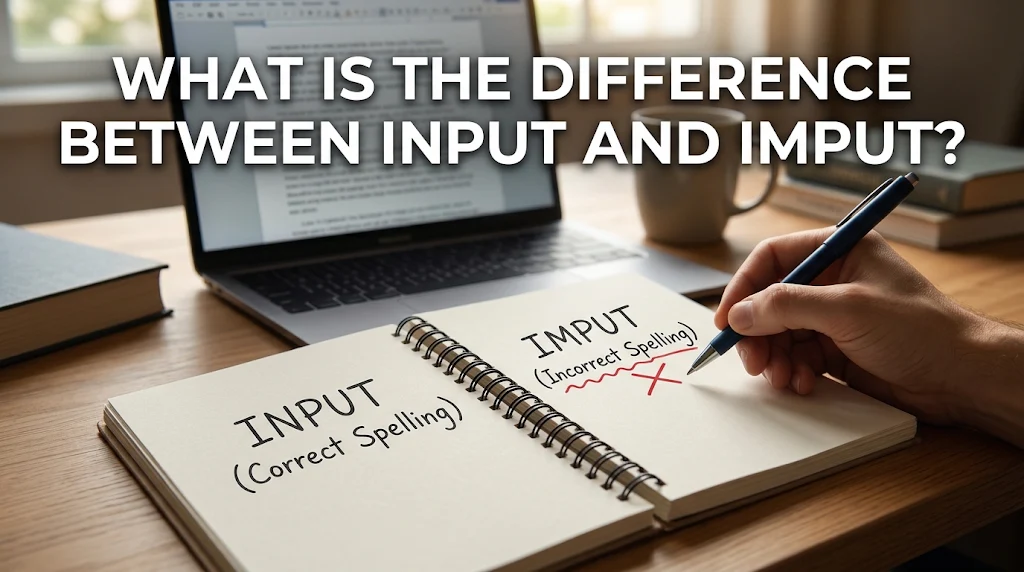
The main difference between input and imput is that input is the correct English word, while imput is an incorrect spelling.
Input is a noun and a verb. It generally refers to information, advice, data, or something supplied to a person, machine, or system.
On the other hand, imput is not a standard English word. It is usually a spelling mistake caused by confusion about pronunciation or the correct arrangement of letters.
Definition of Input
According to standard English usage, input means information, ideas, instructions, or data provided to someone or something for consideration or processing.
Examples:
- The teacher asked students for their input on the new classroom rules.
- Please input your password to access your account.
In simple words, input means giving information, sharing an opinion, or entering data.
Is Imput a Word?
No, imput is not an accepted standard English spelling.
People sometimes write it accidentally when they mean input. However, dictionaries recognize input, not imput, as the correct spelling.
Remember:
- Correct: Input
- Incorrect: Imput
- Correct spelling: I-N-P-U-T
Urdu hint: Input کا مطلب معلومات دینا، رائے فراہم کرنا، یا ڈیٹا داخل کرنا ہے۔
Input vs Imput: Understanding the Correct Spelling
Understanding the spelling difference can help you avoid mistakes in everyday communication.
The word input contains five letters:
- I
- N
- P
- U
- T
The incorrect version, imput, replaces the letter n with m.
Although these letters may sound similar in some situations, they are not interchangeable in this word.
Why Do People Write Imput Instead of Input?
There are several reasons why English learners make this spelling mistake.
1. Pronunciation Confusion
Some speakers pronounce words quickly, making certain consonant sounds difficult to distinguish.
2. Typing Mistakes
People sometimes press the wrong key while typing on a keyboard or mobile phone.
3. Limited Vocabulary Knowledge
Learners who have not seen the word frequently may not remember its correct spelling.
4. Influence of Similar Words
Words such as important, improve, and impossible contain the letter combination “im.” This may cause confusion when writing input.
The easiest solution is to remember that the correct spelling is always INPUT.
Input Meaning and Definition in English
The word input has several meanings depending on the situation.
Let’s explore its most common uses.
1. Input as Information or Advice
Input can describe ideas, suggestions, or opinions provided by another person.
Examples:
- I appreciate your input during the meeting.
- The manager welcomed everyone’s input before making a decision.
- Your input will help us improve our website.
In this context, input means an opinion or contribution.
2. Input as Data Entered Into a Computer
In technology, input refers to information entered into a computer, application, or electronic device.
Examples:
- Enter your input in the search box.
- The computer processes input and produces output.
- The user provided the correct input to the software.
Common forms of computer input include:
- Keyboard typing
- Mouse clicks
- Voice commands
- Touchscreen actions
- Scanned documents
3. Input as a Verb
Input can also function as a verb. It means to enter information or data into a system.
Examples:
- Please input your personal details.
- She input the information into the database.
- The employee will input the customer records tomorrow.
4. Input in Business and Education
In business, input often means advice, feedback, or contributions from employees and customers.
In education, it can refer to information or knowledge that students receive from teachers, books, and learning materials.
Examples:
- The company needs customer input to improve its services.
- Reading provides useful language input for English learners.
Formula and Structure: How to Use Input Correctly

The word input does not have a fixed grammatical formula like a verb tense. However, you can use different sentence structures depending on whether it functions as a noun or a verb.
| Sentence type | Structure | Example |
|---|---|---|
| Positive (noun) | Subject + verb + input | Your input is valuable. |
| Negative (noun) | Subject + do/does not + verb + input | I do not need your input. |
| Question (noun) | Do/Does + subject + need + input? | Do you need my input? |
| Positive (verb) | Subject + input + object | I input the data. |
| Negative (verb) | Subject + do/does not + input + object | I do not input incorrect data. |
| Question (verb) | Do/Does + subject + input + object? | Do you input the information? |
Important grammar tip: When using input as a noun, it can be singular or uncountable depending on the meaning. For example, “Your input is helpful” is a natural expression.
When using input as a verb, its past tense and past participle are generally input or inputted. Both forms are accepted, although input is common in many technical contexts.
Rules and Uses of the Word Input
Learning a few simple rules will help you use input correctly in different situations.
Rule 1: Use Input When Asking for Opinions
Use input when discussing someone’s thoughts, suggestions, or feedback.
Examples:
- I would like your input on this project.
- The teacher requested input from all students.
- Her input helped us solve the problem.
Rule 2: Use Input for Computer Information
When entering information into a digital device, use input.
Examples:
- Input your email address to continue.
- The computer requires input from the user.
- You must input the correct code.
Rule 3: Use Input When Discussing Contributions
Input can describe someone’s contribution to a discussion, project, or decision.
Examples:
- Everyone’s input made the project successful.
- We value your input during team discussions.
Rule 4: Use Input as a Verb
Use input when describing the action of entering information into a system.
Examples:
- I need to input these numbers into the spreadsheet.
- She input the student’s information into the system.
Rule 5: Use Input in Technology and Programming
In computing, input describes data or instructions supplied to a computer program.
Examples:
- The program accepts numerical input.
- Incorrect input may produce an error message.
- The application requires user input before continuing.
15 Input Examples in Sentences
Here are 15 simple input examples in sentences to help you understand the word in everyday English.
- Your input is important to our team.
- Please input your name in the required field.
- The teacher appreciated my input during the discussion.
- We need more input before making a final decision.
- The computer cannot work without proper input.
- She provided valuable input for the project.
- Please check your input before submitting the form.
- The manager asked employees for their input.
- I forgot to input my phone number.
- Customer input helps businesses improve their products.
- The software requires additional input.
- Students can provide input about classroom activities.
- He input the wrong password several times.
- Your feedback and input are always welcome.
- The system processes input and generates useful results.
These sentences show how input works as both a noun and a verb.
Common Input Spelling Mistakes
English learners sometimes make spelling mistakes because similar-looking words can be confusing.
Here are some common mistakes involving input and imput.
| Incorrect sentence | Correct sentence | Explanation |
|---|---|---|
| Please imput your name. | Please input your name. | Input is the correct spelling. |
| I need your imput. | I need your input. | Imput is incorrect. |
| She imput the data. | She input the data. | The verb should be spelled input. |
| Your imput is valuable. | Your input is valuable. | Use input when discussing opinions. |
| Enter your imput here. | Enter your input here. | Use the correct spelling in instructions. |
How to Avoid This Spelling Mistake
Follow these simple tips:
- Memorize the spelling I-N-P-U-T.
- Read English articles and books regularly.
- Use a dictionary when you are unsure about a word.
- Check your writing before submitting it.
- Practice writing sentences using input.
Quick reminder: Whenever you mean information, advice, feedback, or data entered into a system, write INPUT, never IMPUT.
Input vs Similar English Words: A Comparison

Understanding similar words can improve your vocabulary and help you communicate more accurately.
| Word | Meaning | Example |
|---|---|---|
| Input | Information or data supplied | Your input is useful. |
| Output | Information or results produced | The computer displays the output. |
| Feedback | A response or opinion | I received positive feedback. |
| Advice | A suggestion about what to do | She gave me useful advice. |
| Data | Facts or information | The system stores data. |
| Imput | Incorrect spelling of input | Imput is not standard English. |
Input vs Output
Input and output are commonly used together, especially in technology.
- Input: Information entered into a system.
- Output: Results produced by a system.
Example:
When you type a question into a search engine, your question is the input. The search results are the output.
Input vs Feedback
These words are related but have slightly different meanings.
Input can include ideas, opinions, suggestions, or information provided before or during a decision.
Feedback usually refers to a response about something that has already been done or presented.
Example:
- The manager requested input before starting the project.
- The manager received feedback after completing the project.
Quick Practice: Test Your Understanding
Now it is time to check what you have learned about input vs imput.
Choose the correct answer for each exercise.
Exercise 1: Which spelling is correct?
a) Imput
b) Input
Exercise 2: Fill in the blank:
Please _____ your email address.
a) imput
b) input
Exercise 3: Is imput a standard English word?
a) Yes
b) No
Exercise 4: What does input mean?
a) Information or data provided
b) A spelling error
Exercise 5: Choose the correct sentence.
a) Your imput is important.
b) Your input is important.
Exercise 6: Complete the sentence:
The computer needs user _____.
a) input
b) imput
Exercise 7: Which word means the result produced by a computer?
a) Input
b) Output
Exercise 8: Choose the correct sentence.
a) She input the information into the system.
b) She imput the information into the system.
Practice Answers
- b) Input
- b) Input
- b) No
- a) Information or data provided
- b) Your input is important.
- a) Input
- b) Output
- a) She input the information into the system.
If you answered all eight questions correctly, you understand the basic difference between input and imput.
Conclusion
Understanding input vs imput is important for improving your English spelling and communication. Remember that input is the correct word, while imput is a spelling mistake. Input can refer to information, opinions, advice, or data entered into a computer system. Practice using it in everyday sentences, check your spelling regularly, and continue learning common English words to become a more confident writer.
Frequently Asked Questions (FAQs)
Is it Input or Imput?
Input is the correct spelling. Imput is a common spelling mistake and is not accepted as a standard English word.
What Is the Meaning of Input in English?
Input means information, ideas, advice, or data provided to a person, computer, or system. It can also mean entering information into a digital device.
Why Do People Spell Input as Imput?
People often confuse the letters “n” and “m” when pronouncing or typing the word. Limited spelling practice and typing mistakes can also cause this error.
What Is the Past Tense of Input?
The past tense can be input or inputted. For example, “She input the information yesterday” and “She inputted the information yesterday” are both acceptable.